Crystal Market Fraud Detection and Retailer Verification Framework
The Crystal Market Fraud Detection and Retailer Verification Framework operates as a sophisticated, multi-dimensional technical protocol engineered to validate the mineralogical integrity and digital provenance of gemstones within a globalized supply chain.
This system facilitates the ability to identify authentic gemstones while mitigating the risks associated with lab-grown crystals sold as natural stones. By integrating advanced crystallographic analysis—including spectroscopic fingerprinting—with decentralized ledger technology, the framework eliminates information asymmetry between producers and end-users.
Consequently, this rigorous technical baseline serves as a primary defense to avoid counterfeiting in the crystal market and stabilize trade practices.
Molecular Verification
Utilization of 10x magnification and UV-Vis-NIR spectroscopy to identify cellular growth features in hydrothermal gemstones and seed plate remnants.
Piezoelectric Profiling
Assessment of silicon dioxide’s capacity to generate electrical charges under mechanical stress—a definitive marker for crystalline quartz.
Immutable Ledgering
Deployment of a supply chain traceability blockchain for minerals to record every node transition from extraction to final retailer.
Structural Anomaly Detection
Implementation of AI-driven monitoring to identify fabricated personas and ensure users can spot fake healing crystals before they enter the retail stream.
4Cs Standardization
Rigorous adherence to GIA-standardized scales for Cut, Color, Clarity, and Carat weight to accurately determine the worth of your diamond jewelry product.
I. Molecular Architecture and Synthetic Genesis Protocols
The foundation of modern fraud detection necessitates a comprehensive understanding of material genesis. Gemological experts observe that sophisticated science now mimics geological processes on an accelerated timeline, creating specific structural signatures that deviate from natural formations.
# The Hydrothermal Synthesis Mechanism
The hydrothermal growth process occurs within an autoclave, a high-pressure vessel designed to simulate extreme subterranean environments. This process relies on a precise causal chain where a temperature gradient is established to dissolve a nutrient source, typically low-grade quartz, in a mineralizer solution of sodium carbonate.
As temperatures reach 300°C to 400°C, the solution rises via convection to a cooler growth zone. Here, the quartz precipitates onto seed crystals at a rate of 0.4 mm to 1.0 mm per day. While chemically identical to natural specimens, these stones possess a distinct internal "biography" that professionals must recognize when they pick a wholesale crystal supplier.

# Trace Element Chromophores and Piezoelectric Properties
Crystal coloration is primarily the result of trace elements or "chromophores" absorbing specific light wavelengths. Within this verification framework, the presence of iron (Fe) in specific oxidation states determines the manifestation of amethyst or citrine.
Spectroscopic Analysis Data
Verification utilizes irradiation analysis to discern if these colors were induced in a laboratory or via natural radioactive decay.
Furthermore, the framework leverages the piezoelectric property of quartz to generate an electric charge under pressure. If a specimen fails to exhibit this attribute, it is classified as a glass simulant. Such technical scrutiny is essential when evaluating intention and purpose-driven crystal sets or crystals for emotional wellness and self-care, which are often marketed based on these inherent physical properties in historical traditions.
# Structural Anomalies and Identification Markers
"Under 20x magnification, the cellular growth features in hydrothermal gemstones appear as parallel 'wheat-sheaf' patterns absent in natural formations."
These features arise because synthetic crystals grow at asymmetrical speeds. The framework mandates the identification of the "seed plate," a flat starter layer at the crystal’s core. While natural stones contain irregular inclusions, synthetic alternatives often appear "too perfect."
Identifying hexagonal color zoning remains a primary test, as fraudulent specimens frequently display unnatural dye concentrations in surface cracks. Maintaining these standards is vital to ensure competitive unit prices for bulk crystals reflect true geological rarity.
II. Diamond Stratification and Advanced Carbon Synthesis
HPHT vs. CVD Synthesis Pathways
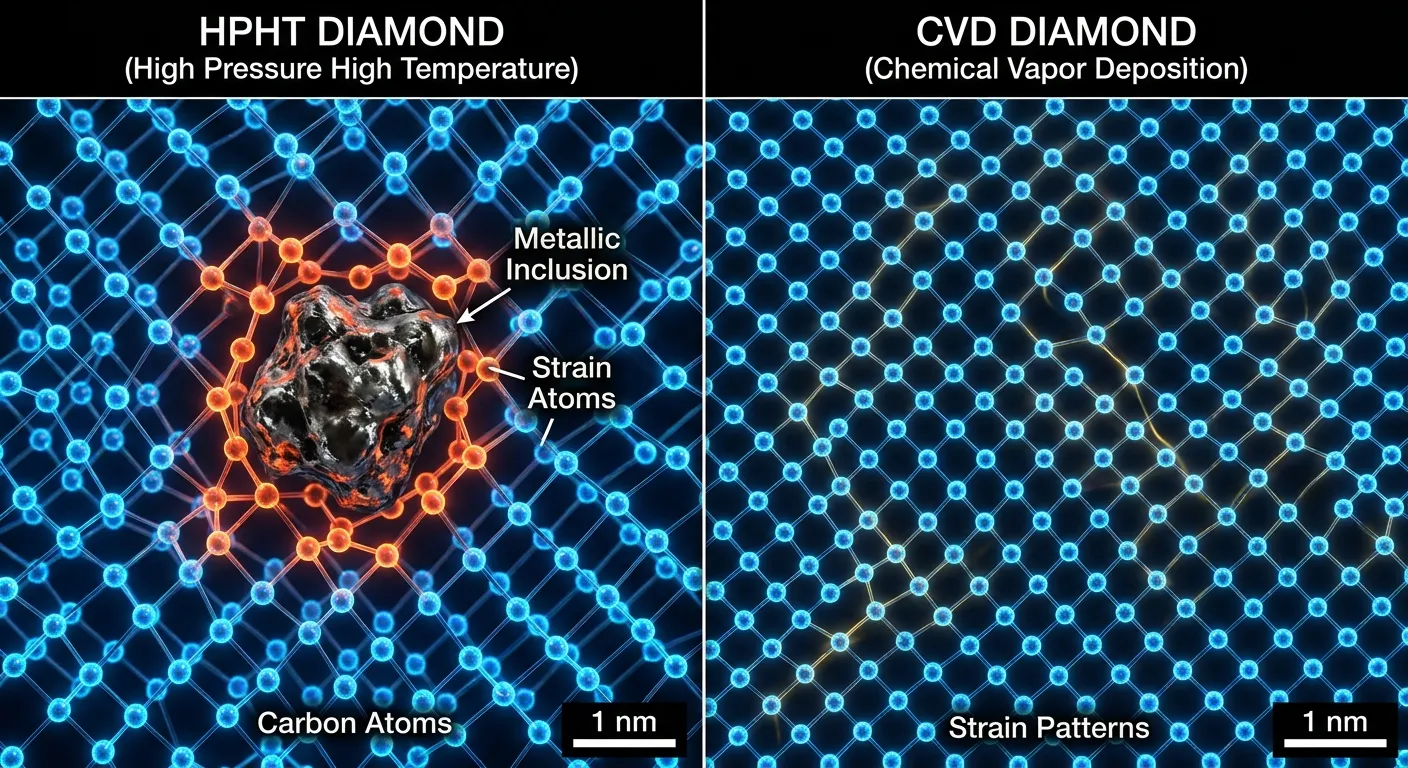
The two primary methods for laboratory diamond synthesis—High Pressure High Temperature (HPHT) and Chemical Vapor Deposition (CVD)—leave distinct markers in the atomic lattice. HPHT utilizes a metal catalyst to dissolve carbon, often leaving microscopic metallic inclusions detectable via high-powered magnets.
Conversely, CVD employs a plasma cloud in a vacuum to deposit carbon layers, resulting in specific strain patterns visible under cross-polarized light. The framework utilizes these patterns to differentiate between millions of years of geological pressure and the brief growth cycles of industrial laboratories.
Type IIa Classification and Nitrogen Impurity Profiling
A critical component of the verification framework is the "Type" classification. Type IIa diamonds are chemically pure, containing virtually no nitrogen impurities. While only 1-2% of natural diamonds are Type IIa, nearly all high-quality CVD lab-grown diamonds fall into this category.
Detecting nitrogen levels through infrared spectroscopy allows verifiers to flag stones for secondary screening. This protocol utilizes photoluminescence to reveal post-growth treatments, such as HPHT annealing, ensuring that landed costs for wholesale crystals are aligned with their actual production method.
Spectroscopic Fingerprinting and Optical Performance Analysis
The framework employs spectroscopic fingerprinting to create a unique optical ID for high-value stones, measuring light interaction across the electromagnetic spectrum. Beyond the standard 4Cs, the framework integrates metrics for brilliance, fire, and scintillation.
Advanced UV-Vis-NIR spectrophotometers detect trace elements like boron or hydrogen characteristic of specific regions. This data is essential for maintaining blockchain-verified sustainability credentials for gemstones, ensuring that any enhancement is disclosed through technical documentation rather than subjective claims.
III. Digital Provenance and Blockchain-Enabled Traceability
Immutable Ledger Architecture
The core of the digital framework is the distributed ledger, which ensures that records, such as grading reports, cannot be altered without network consensus. This immutability serves as a deterrent against "greenwashing."
Smart contracts automate the verification process; for instance, a retailer cannot claim a stone is "Ethically Sourced" unless the contract validates a digital signature from a certified mine. This replaces manual audits with real-time cryptographic validation, securing the supply chain traceability blockchain for minerals.
API Integration and Node-Level Transparency
To achieve transparency, suppliers integrate their Enterprise Resource Planning (ERP) systems with the blockchain via API. This allows for real-time node updates, where every change in ownership is logged.
Such connectivity ensures that Digital Product Passports remain current. For example, if a Tanzanite stone's weight increases between its raw state in Merelani and its final certification in New York, the framework triggers an automatic fraud alert. This prevents "salting" and ensures the integrity of competitive unit prices for bulk crystals.
Digital Product Passports and ESG Compliance Logic
Environmental, Social, and Governance (ESG) compliance is increasingly mandated by luxury conglomerates. The framework uses blockchain to substantiate these claims by recording immutable evidence of labor conditions.
The Digital Product Passport serves as a gemstone's biography, containing technical specs and a "Social Fingerprint" regarding living wages and environmental restoration. By anchoring these metrics, the framework eliminates the digital capability gap between high-tech retailers and artisanal mines, providing blockchain-verified sustainability credentials for gemstones.
IV. Forensic Fraud Detection and AI-Driven Risk Mitigation
Synthetic Identity Construction and Generative AI Countermeasures
Fraudsters currently utilize Generative AI to create "synthetic identities" that combine real and fake data. The framework employs detection algorithms to identify machine-generated patterns that fail logic tests.
Furthermore, AI-powered Document Fraud Detection analyzes digital certificates to prevent the cloning of grading reports. The framework cross-references every report against the issuing laboratory’s database in real-time, ensuring the digital twin matches the physical specimen to accurately determine the worth of your diamond jewelry product.
Behavioral Biometrics and Anomaly Detection Algorithms
The framework monitors unique patterns in user interaction, such as transaction velocity and keystroke dynamics. Fraud rings often exhibit volatility in these signals, which the framework identifies as a "Tumbling Risk Score."
By establishing a baseline for a verified retailer, the system can detect Account Takeover (ATO) attempts. If a wholesaler suddenly changes their typical transaction size or location, the AI triggers "Smart Friction" to prevent unauthorized transfers. This methodology supports a verified retailer whitelist and helps the industry spot fake healing crystals at the source.
Forensic Valuation Standards
To ensure a stone’s value is backed by science, the framework adheres to USPAP compliance. This requires a forensic valuation approach, including spectroscopic origin verification.
Historical market observations indicate that natural stones often command valuation premiums of 5x-8x over synthetic counterparts due to scarcity. Forensic valuation ensures these categories are never conflated, preventing "First-Party Fraud."
Through global anti-fraud alerts, the framework continuously updates its database of deceptive trade names to protect the market from lab-grown crystals sold as natural stones.
V. Practical Applications and Market Dynamics: Navigating the 2026 Crystal Economy
The global gemstone sector in 2026 has transitioned from a niche metaphysical interest into a high-stakes wellness lifestyle category. Current procurement standards dictate that market vigilance is no longer optional; rather, it forms the absolute baseline for commercial viability.
Driven by digital media trends, this demand surge has inadvertently cultivated sophisticated deceptive business practices. These range from mislabeled hydrothermal synthetics to AI-generated synthetic identity fraud during high-value transactions.
Economic Disparity and Asset Classification
To identify authentic gemstones within this complex climate, procurement professionals must evaluate metrics far beyond superficial optical performance. The prevailing commercial reality reveals that lab-grown crystals sold as natural stones frequently represent a 500% to 1,000% markup over their fundamental baseline valuation.
For instance, historical market observations indicate a lab-grown quartz cluster acquired for $5 to $20 wholesale is routinely repositioned for over $100 in retail environments under the guise of earth-mined origins. Distinguishing between visual aesthetics and geological legacy remains critical for institutional buyers.
Natural minerals function as legacy assets, maintaining valuation due to finite geological supply and established resale liquidity.
Strategic Bifurcation: Natural vs. Lab-Grown
The 2026 market framework is defined by a definitive bifurcation. Natural diamonds and rare minerals have solidified their positioning as finite commodities with a historically strengthening value floor. Simultaneously, lab-grown alternatives have matured into a high-volume fashion category.
Consequently, this valuation gap serves as the primary vector for retail fraud, wherein unauthorized distributors exploit the shared visual identity of both categories to obscure massive discrepancies in long-term retained value.
The Rise of the "3-Carat Standard"
Within the lab-grown diamond sector, industry analysts observe the emergence of the 3-Carat Standard. Because consumers can now acquire lab diamond jewelry under $2,000, focus has shifted from geological rarity toward immediate visual impact.
Retailers must maintain strict transparency; the primary utility resides in the aesthetic experience rather than financial retention, as secondary market liquidity typically observes valuations sitting at a modest 20% to 40% of the initial sale price.
VI. Core Industry Standards & Evaluation Metrics
To maintain absolute supply chain integrity and avoid counterfeiting in the crystal market, institutional buyers must adhere to a rigid framework of evaluation metrics. The 2026 overhaul of GIA reporting parameters has established a new benchmark for transparency, particularly regarding origin determination.
The GIA 2026 Origin and Identification Framework
The GIA has systematically expanded its country-of-origin parameters to encompass a wider array of minerals, including spinel, jadeite, and complex garnets. This expansion is critical for accurate appraisals, as verifying whether a demantoid garnet originates from Russia’s Ural Mountains rather than Namibia often correlates with a 3x valuation premium.
Consequently, a modern GIA report functions as a comprehensive gemstone biography, detailing authentic provenance and explicitly outlining any detectable enhancements such as thermal treatments or advanced dye saturation.
- 4Cs: Cut, Color, Clarity, Carat
- Cellular Growth Signatures
- Spectroscopic Origin ID
- ESG Compliance Node
Cellular Growth Features
When analyzing cellular growth features in hydrothermal gemstones, gemologists specifically screen for parallel growth lines or chevron patterns. These microscopic structures provide definitive proof that a specimen was artificially manufactured.
Certification Premiums
Specimens accompanied by a GIA certificate frequently command a 5% to 15% valuation premium over IGI equivalents, reflecting the market's perception of the GIA as a more conservative grading authority.
Protocols to Verify Ethical Gemstone Provenance
Ethical sourcing methodologies have transitioned from optional marketing narratives into strict regulatory requirements. To verify ethical gemstone provenance, corporate whitelists now mandate immutable proof of ESG compliance.
This documentation framework includes CITES clearance for organic materials, alongside conflict-free certifications. Modern buyers increasingly demand node-level transparency directly from tier-3 mining and agricultural suppliers to satisfy global transparency mandates.
VII. Risk Mitigation & Fraud Detection Framework
Case Study: The Hydrothermal Emerald Deception
During a recent high-profile industry audit, investigators discovered a major retail chain unknowingly stocking natural Colombian emeralds that were, in reality, high-quality hydrothermal synthetics. This fraud was only intercepted when a senior appraiser identified the colorless seed crystal—a microscopic plate utilized to initiate artificial growth—deliberately concealed near the jewelry mounting.
The enterprise incurred massive losses in compromised brand equity and direct refund liabilities due to specimens that appeared mathematically perfect.
Detecting Deceptive Trade Names
Unauthorized distributors frequently utilize fantasy nomenclature to obscure the fundamental nature of an inventory asset. Commercial terms such as "Aqua Aura" or "Cobalt Quartz" typically designate natural quartz substrates subjected to laboratory-grade metallic vapor deposition.
How to Spot Fake Healing Crystals
- 01. Thermal Depression: Genuine quartz remains cold to the touch; glass replicas warm quickly to body temperature.
- 02. Inclusion Analysis: Look for jagged fluid inclusions vs. perfectly spherical air bubbles found in glass.
Mitigating Synthetic Identity Fraud
Financial criminals are increasingly blending legitimate and fabricated corporate data to establish fraudulent wholesale accounts. Procurement organizations must aggressively overhaul internal fraud-risk frameworks to detect AI-generated compliance documents.
The 2026 market has integrated the supply chain traceability blockchain for minerals to neutralize corporate greenwashing through immutable digital ledgers.
VIII. Strategic Procurement & Supply Chain Auditing
To successfully pick a wholesale crystal supplier in the 2026 fiscal landscape, buyers must execute due diligence far beyond a basic price-per-carat comparison. This process demands an uncompromising audit of logistical infrastructure and quality control feedback loops.
Calculating Landed Costs
If an enterprise imports 100kg of material but 8kg arrives fractured due to substandard packaging, the effective unit cost instantly spikes by 8%. This formula is vital to determine the worth of your diamond jewelry product.
Advanced Vetting Protocols
A legitimate corporate signal always includes a verifiable commercial street address and documented executive personnel. Institutional buyers should always stress-test new partners with a $500 to $1,500 preliminary order before committing to scaled acquisitions.
HS Code Accuracy
Incorrectly applying a rough stone classification to a finished carving constitutes a severe regulatory red flag, triggering exhaustive customs audits and financial penalties.
Watch-While-You-Wait Appraisal
For high-value acquisitions, exclusively contract independent gemologists who facilitate on-site appraisal services to eliminate the risk of illicit stone switching.
Procurement Tip
Local distributors may present a higher initial sticker price, yet they consistently offer reduced inventory shrinkage and accelerated replenishment cycles.
IX. 2026 Global Market Forecast & ESG Integration
The macroeconomic future of the mineral trade relies heavily on the implementation of Digital Product Passports. By 2027, approximately 60% of global supply chains will adopt cryptographic ledgers to satisfy rigorous ESG compliance mandates.
The Shift Toward Intentional Storytelling
Modern retail demographics are no longer merely purchasing a geological artifact; they are investing in a curated design philosophy. Consequently, intention and purpose-driven crystal sets—specifically marketed as crystals for emotional wellness and self-care—are currently outperforming raw specimens.
Distributors who successfully merge this intentional storytelling with verifiable scientific certification will inevitably capture the highest echelon of market share.
The Buyer’s Final Verdict
Within the 2026 commercial landscape, the gemstone trade operates as a highly contested battleground of asymmetrical information. Long-term operational success requires the technical capacity to demystify industry jargon and calculate logistical expenditures with surgical precision.
"The ultimate source of truth remains anchored in empirical data and accredited certification."