
Understand Material and Treatment Disclosures
When a gemstone listing says “natural,” “synthetic,” “treated,” or “untreated,” it answers only part of the buyer’s question. CIBJO gemstone treatment terminology provides a framework for describing materials, construction, and modification, but standards-based language, seller wording, and laboratory findings are not interchangeable.
Start by separating four things:
- What can be observed.
- What the seller reports.
- What the relevant term is intended to mean.
- What remains unresolved without appropriate gemological examination.
A photograph may show color distribution, transparency, surface texture, visible inclusions, or an apparent boundary. It cannot by itself confirm composition, natural or manufactured formation, treatment status, geographic origin, construction, or stability.
The practical goal is not to identify every stone from its appearance. It is to determine what the listing establishes, what it suggests, and what needs clarification before the information can support a purchase decision.
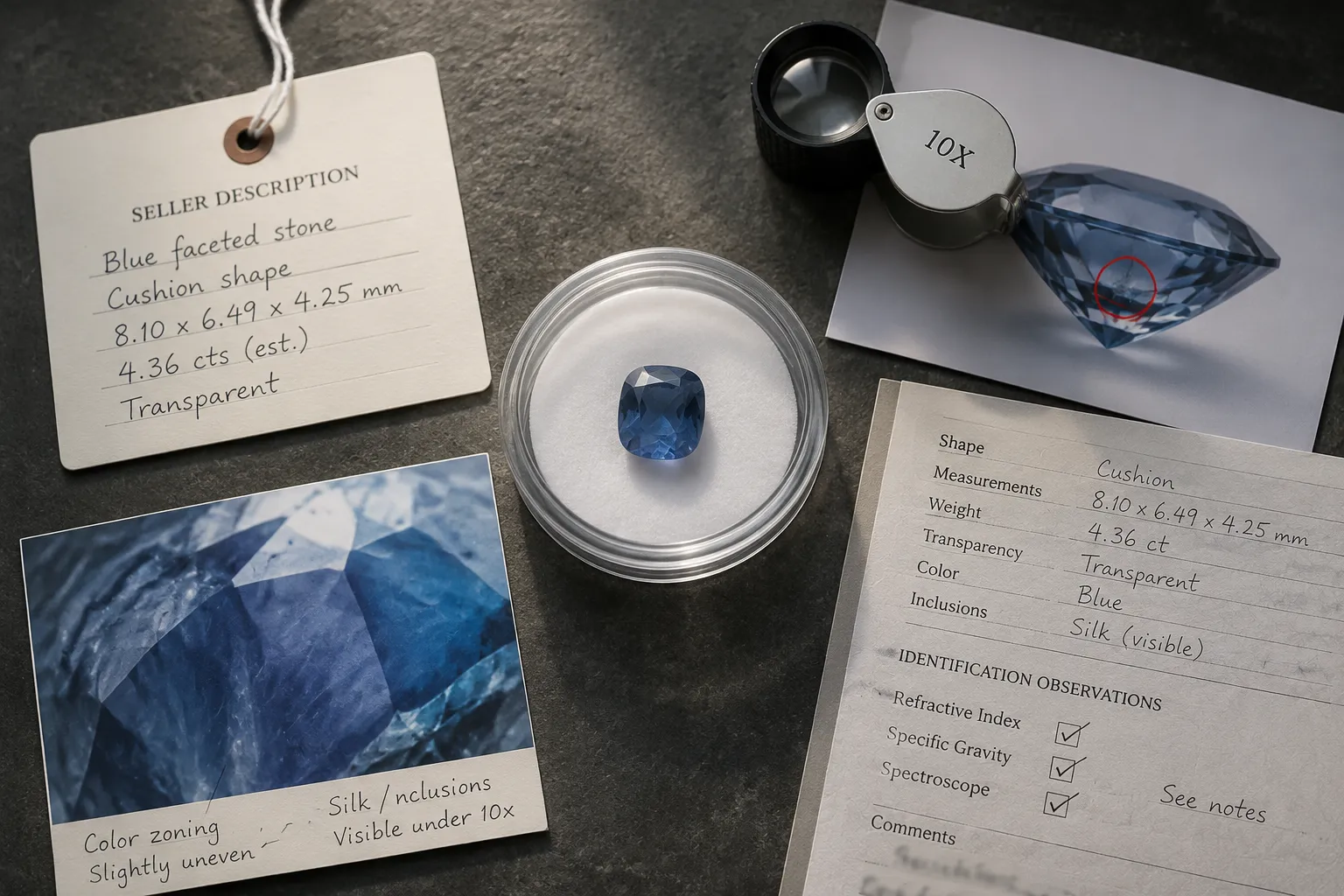
Read a Disclosure as Four Separate Questions
Gemstone descriptions often compress several claims into one short label. “Natural blue sapphire,” for example, includes a claimed material identity and natural formation, while “treated natural blue sapphire” adds a modification claim. Neither phrase necessarily explains how the conclusion was reached, whether the stone is assembled, what treatment was applied, or whether an origin claim is also being made.
A useful review separates the description into four fields:
| Question | What it covers | What may support an answer |
|---|---|---|
| What is the material? | Natural material, a manufactured counterpart, an imitation, reconstructed material, or another category | Precise seller wording, item-specific documentation, or examination |
| How is the item constructed? | One piece, an assembled stone, a composite, a coating, or re-formed material | Description, close inspection, or gemological examination |
| Has it been modified? | Treatment affecting color, clarity, surface appearance, durability, or another characteristic | Treatment disclosure, technical documentation, or examination |
| How well is the statement supported? | Observation, seller report, professional opinion, or laboratory finding | The source, methods, scope, and limitations of the information |
These questions must remain separate. A gemstone can be natural and treated. A manufactured counterpart is not automatically an imitation. An assembled item may contain natural gemstone material without being one continuous piece of that material.
Geographic origin is another distinct question. Identifying a material does not necessarily establish where it formed, and treatment findings do not necessarily establish origin.
Observation, Report, and Confirmation
An observation describes what is directly visible or documented without assigning a cause:
- The photograph shows uneven color.
- A line or boundary appears near the edge.
- The seller describes the material as transparent and blue.
- One area looks cloudy or filled.
- The listing states that the stone was dyed.
Such details can guide follow-up questions, but they do not automatically identify the material or explain how it was produced.
A seller label should be recorded as a reported claim:
- “The seller identifies the material as natural.”
- “The listing discloses treatment but does not name the process.”
- “The description does not address whether the item is assembled.”
- “The seller uses ‘untreated,’ but no supporting report is shown.”
This attribution is not an accusation. It simply preserves the difference between a commercial representation and an independently examined finding.
Use certainty language consistently:
| Term | Appropriate use |
|---|---|
| Observed | A feature is visible in the item or photograph |
| Reported | A seller, laboratory, or other named source states it |
| Consistent with | The information fits one or more possible explanations |
| Possible | An explanation cannot be excluded |
| Indicated | Examination supports a conclusion but its scope or certainty is limited |
| Confirmed | An appropriate examination establishes the conclusion within its stated scope |
“No treatment detected” should not be silently rewritten as “untreated.” The first describes an examination result; the second can sound like a broader conclusion than the report supports.
Material Categories Are Not a Real-or-Fake Scale
The main material terms answer different questions. Treating them as rankings from “real” to “fake” hides distinctions that matter for description, care, and comparison.
| Category | What the term addresses | What it does not establish by itself |
|---|---|---|
| Natural material | Formation through natural geological or organic processes | Treatment status, geographic origin, value, rarity, condition, or independent verification |
| Synthetic material | A manufactured material corresponding to a natural counterpart under the applicable terminology | Manufacturing method, additional treatment, construction, stability, or report status |
| Imitation or simulant | A material used to resemble another gemstone without sharing its identity | The actual composition unless it is separately named |
| Assembled or composite | An object made from multiple pieces or materials | Whether every component is natural, synthetic, treated, or of the same identity |
| Reconstructed material | Material processed and re-formed from fragments, particles, or previously existing material | The precise method, binder, composition, or stability unless disclosed |
| Treated material | Material modified by a process affecting appearance or another relevant characteristic | Natural or manufactured formation, construction, treatment extent, stability, or care requirements |
Exact definitions and prescribed naming can change between editions or differ by product category. For publication-level wording, consult the applicable edition in CIBJO’s official Blue Books collection rather than relying on retailer summaries, old mirrored documents, or proposed terminology.
Natural does not mean untreated
A natural gemstone may be heated, dyed, filled, impregnated, coated, irradiated, diffused, waxed, or otherwise modified. It may also be cut, drilled, repaired, or incorporated into an assembled object. “Natural” addresses formation; the other questions still require answers.
Synthetic does not mean imitation
Within standards-based gemstone terminology, synthetic material is described in relation to a natural counterpart. An imitation instead resembles another material without having that identity. Marketing expressions such as “laboratory-created,” “laboratory-grown,” or “created” should be read in context and checked against the terminology applicable to the specific product.
Resemblance is not identity
Phrases such as “ruby-like,” “diamond alternative,” or “sapphire simulant” may describe appearance rather than composition. Ask whether the named gemstone is the actual material, a manufactured counterpart, or merely the visual reference.
Artificial is too broad to resolve the category
The word may appear in older documents or informal retail descriptions, but it should not automatically be converted into synthetic, imitation, or laboratory-grown. The seller should identify the material more precisely.
Construction and treatment are separate
An assembled stone may contain joined sections of gemstone and other materials. A reconstructed product may consist of processed material that has been bonded or re-formed. Either product may also have a separate color, clarity, filling, or surface treatment.
A visible seam, sharp boundary, or change in transparency may justify asking about construction. It does not confirm a doublet, triplet, composite, coating, or reconstructed product from a photograph alone.
Audit the Listing Before Interpreting It
A disclosure audit works for loose stones, finished jewelry, carvings, beads, and listings that use gemstone language loosely. The process is short enough to repeat while keeping unsupported conclusions out of the notes.
1. Copy the exact wording
Record the seller’s description before translating it into your own terms. Look for words such as:
- Natural
- Synthetic
- Laboratory-grown or laboratory-created
- Imitation or simulant
- Assembled or composite
- Reconstructed or reconstituted
- Treated or enhanced
- Untreated
- No treatment information supplied
Note where the information appears. A term in a specification field may be qualified by a footnote, symbol key, image, or separate disclosure page. Information placed behind an unexplained abbreviation or an easily missed note deserves clarification.
2. Rewrite the description into separate statements
Use a simple record:
- Material claimed: What does the seller say the item is?
- Formation stated: Is it described as natural or manufactured?
- Construction stated: Is it one piece, assembled, composite, coated, or reconstructed?
- Treatment stated: Is a modification named?
- Origin stated: Is a geographic source claimed?
- Support offered: Is an item-specific report or other documentation identified?
This rewrite exposes gaps that polished product language can conceal. “Natural treated gemstone” leaves the treatment unnamed. “Laboratory gemstone” may not distinguish a synthetic counterpart from a different manufactured material. “Untreated” may be an unsupported statement rather than a laboratory finding.
3. Check the scope of any documentation
A report is useful only for the questions it addresses. Read it rather than relying on the seller’s summary.
Check whether:
- The document corresponds to the specific item.
- The item or specimen identifier matches.
- Material identity is stated.
- Treatment, construction, and origin are addressed separately.
- The wording says detected, indicated, not detected, or something else.
- The date and limitations are visible.
- The issuing source can be identified.
- The seller’s claim goes beyond the report’s conclusion.
A report may identify a gemstone while leaving its geographic origin unresolved. It may record a treatment without describing every care implication. Its conclusion concerns the specimen and examination covered by that document, not every similar-looking item.
4. State the unresolved point
End the audit with one plain sentence:
The material is described as natural, but treatment status is not stated.
The listing says synthetic, but the corresponding material and construction are unclear.
A treatment is disclosed, but the process and care implications are not identified.
The photograph shows a possible boundary, but construction cannot be determined from the image.
The report identifies the material but does not support the seller’s geographic-origin statement.
An unresolved point is useful information. It tells you what to ask next and whether the missing answer matters for this purchase.
Use Photographs to Screen Questions, Not Settle Identity
Photographs can document color, transparency, polish, shape, visible inclusions, surface wear, and the features a seller chose to show. Their accuracy depends on lighting, exposure, white balance, focus, reflections, processing, cropping, screen settings, viewing angle, and scale.
The same feature can have several causes:
| Visible feature | Productive question | What the image cannot establish alone |
|---|---|---|
| Uneven color | Could this be natural variation, dye concentration, coating, or lighting? | Material identity or treatment method |
| Very uniform appearance | Could manufacturing, selection, cutting, or image processing explain it? | Synthetic status or absence of treatment |
| Surface line or film | Is it abrasion, a reflection, coating, filling, or another feature? | Composition and cause |
| Apparent seam | Could the object contain joined sections? | Assembled construction |
| Cloudy or filled-looking area | Is this internal structure, damage, filling, or photographic distortion? | A specific filling process |
| Sharp color boundary | Could zoning, surface modification, dye, or lighting explain it? | Treatment status or geographic origin |
| Unexpected transparency | Does the listing need a more precise material description? | Conclusive identification |
Describe the feature before interpreting it. “The image shows a sharp color boundary” preserves what can be seen. “The stone is dyed” assigns a cause that the photograph may not establish.
Several observations can make one explanation more plausible, but they do not automatically exclude alternatives. Visual review is most useful when it produces a better seller question or shows that the available listing is too incomplete for the decision.
Treatment Questions That Follow From a Listing
If treatment is disclosed, ask for enough detail to connect the statement to the material:
- What process is reported?
- What characteristic was modified?
- Is the modification throughout the material, near the surface, or limited to selected areas?
- Is treatment-specific care information available?
- Are there stated limits involving cleaning, heat, chemicals, impact, or repair?
- What document or examination supports the statement?
Heating, dyeing, diffusion, filling, impregnation, waxing, irradiation, laser drilling, and surface modification are broad process categories, not a universal checklist for every gemstone. Their relevance, detectability, stability, and care implications depend on the material and the particular process.
For that reason, “treated” alone is not enough to select a cleaning or repair method. Care guidance should follow the identified material, construction, and treatment rather than a generic assumption.
Keep Material, Treatment, and Evidence on Separate Axes
Many listing errors come from asking one word to do too much. A clearer comparison uses independent decision axes:
| Disclosure axis | Question to answer | Common reading error |
|---|---|---|
| Material identity | What material or gemstone category is present? | Treating “natural” as a complete description |
| Formation | Did it form naturally or was a counterpart manufactured? | Treating synthetic as imitation |
| Resemblance | Is one material being presented in relation to another’s appearance? | Assuming the comparison name identifies the material |
| Construction | Is the item one piece or made from multiple components? | Overlooking joined sections or composite wording |
| Treatment | Was the material modified? | Treating “treated” as proof of a specific process |
| Stability and care | What handling follows from the known material and treatment? | Inferring care from a vague label |
| Support | What establishes each statement? | Treating a photo or seller description as laboratory confirmation |
This framework also helps with words such as “permanent,” “routine,” “special care,” and “untreated.” These may be meaningful in a specific, documented context, but they do not establish universal conclusions.
In particular:
- Treated does not mean imitation.
- Natural does not mean untreated.
- Untreated does not establish desirability, price, or future value.
- A familiar process is not exempt from every disclosure requirement in every market.
- A treatment name does not establish stability for all materials.
- Silence about treatment is not a positive finding that treatment is absent.
- “Laboratory-created” should not be assumed to have exactly the same defined use in every terminology system.
CIBJO, FTC, and GIA Answer Different Questions
The principal references on this topic serve different functions. Keeping those functions distinct prevents trade terminology, consumer guidance, and laboratory practice from being blended into one supposed rule.
| Source | Best use on this page | Important limit |
|---|---|---|
| CIBJO | International trade terminology and nomenclature for gemstone materials, construction, and treatments | A standards framework is not automatically binding law in every country |
| FTC | U.S.-specific guidance concerning jewelry representations and advertising | It does not provide a universal rule or a case-specific legal conclusion |
| GIA | Technical background on treatments, examination, and laboratory reporting | It does not turn one instrument, visual clue, or consumer observation into a conclusive test |
Use CIBJO to check the intended distinction between terms such as natural, synthetic, imitation, assembled, composite, reconstructed, and treated. Exact language should come from the applicable official Gemstone Book, with the Blue Books collection used to check the available edition. A retailer’s paraphrase or an industry proposal may explain why certain wording appears in the market, but it does not replace adopted text.
Use FTC resources as United States business and advertising guidance. They help explain why material information should be presented clearly in the U.S. market, but they should not be restated as worldwide law or used to decide the legal status of an individual transaction.
Use GIA resources to understand why treatment and material analysis may involve microscopy, spectroscopy, refractive measurements, fluorescence behavior, or other methods selected for the specimen and question. No single technique answers every identity, construction, treatment, or origin question. A method may contribute an indication while further examination is needed to distinguish alternatives.
When Documentation or Gemological Examination Matters
Further examination becomes relevant when an unresolved statement could change the purchase decision and the listing cannot answer it. Typical situations include:
- The material category is unclear.
- Natural and synthetic possibilities remain open.
- A simulant could be confused with the named gemstone.
- The object may be assembled, composite, coated, or reconstructed.
- Treatment status affects use, care, repair, or the description being offered.
- “Untreated” is stated without an explained basis.
- A geographic-origin statement matters but is unsupported.
- A supplied report does not cover the seller’s main claim.
- Treatment-specific handling information is needed.
- The seller cannot clarify a material or treatment description.
The answer is not necessarily to test every item. Match the examination to the unresolved question. Distinguishing an assembled construction is a different task from evaluating treatment status or geographic origin.
Before relying on a report, compare its scope with the statement you need to assess:
- Does it identify this item?
- Does it name the material?
- Does it address natural or manufactured formation?
- Does it discuss treatment or construction?
- Is origin included or omitted?
- Are findings qualified?
- Does “not detected” refer to a stated set of methods?
- Is the seller presenting a narrower finding as a broader conclusion?
Professional examination can provide stronger support, but it should still be described within its scope. It does not guarantee future condition, permanence, seller conduct, or every fact associated with the stone.
Common Gemstone Disclosure Misreadings
“Synthetic means imitation.”
These are different categories. A synthetic material is described in relation to a natural counterpart; an imitation resembles another material without sharing its identity.
“Natural means untreated.”
Natural formation and later modification are separate questions.
“Treated tells me what process was used.”
It only reports modification at a broad level unless the process and extent are also named.
“No treatment is listed, so none occurred.”
An omission is not the same as an affirmative finding.
“A photograph shows that the stone is natural.”
Appearance can guide questions, but it cannot resolve composition, formation, treatment, origin, or construction when alternatives remain possible.
“A laboratory report supports every sentence in the listing.”
A report may cover identity while excluding origin, treatment, construction, or other claims. Read the actual findings and limitations.
“An international standard is worldwide law.”
CIBJO supplies an international trade framework. Applicable legal and advertising requirements depend on jurisdiction; FTC guidance is specific to the United States.
“A newly discussed term has already replaced the current standard.”
Proposed terminology should not be presented as adopted wording until its status is verified in the applicable official publication.
The resulting buyer path is simple: preserve the exact listing language, separate material from construction and treatment, identify the support for each statement, and write down what remains unknown. That process does not force an identification from limited information. It produces a clearer decision and a more precise next question.
Sources
Sources and further reading
Reference links are limited to sources considered suitable for public citation in this page.