
Interpret Color and Color Distribution
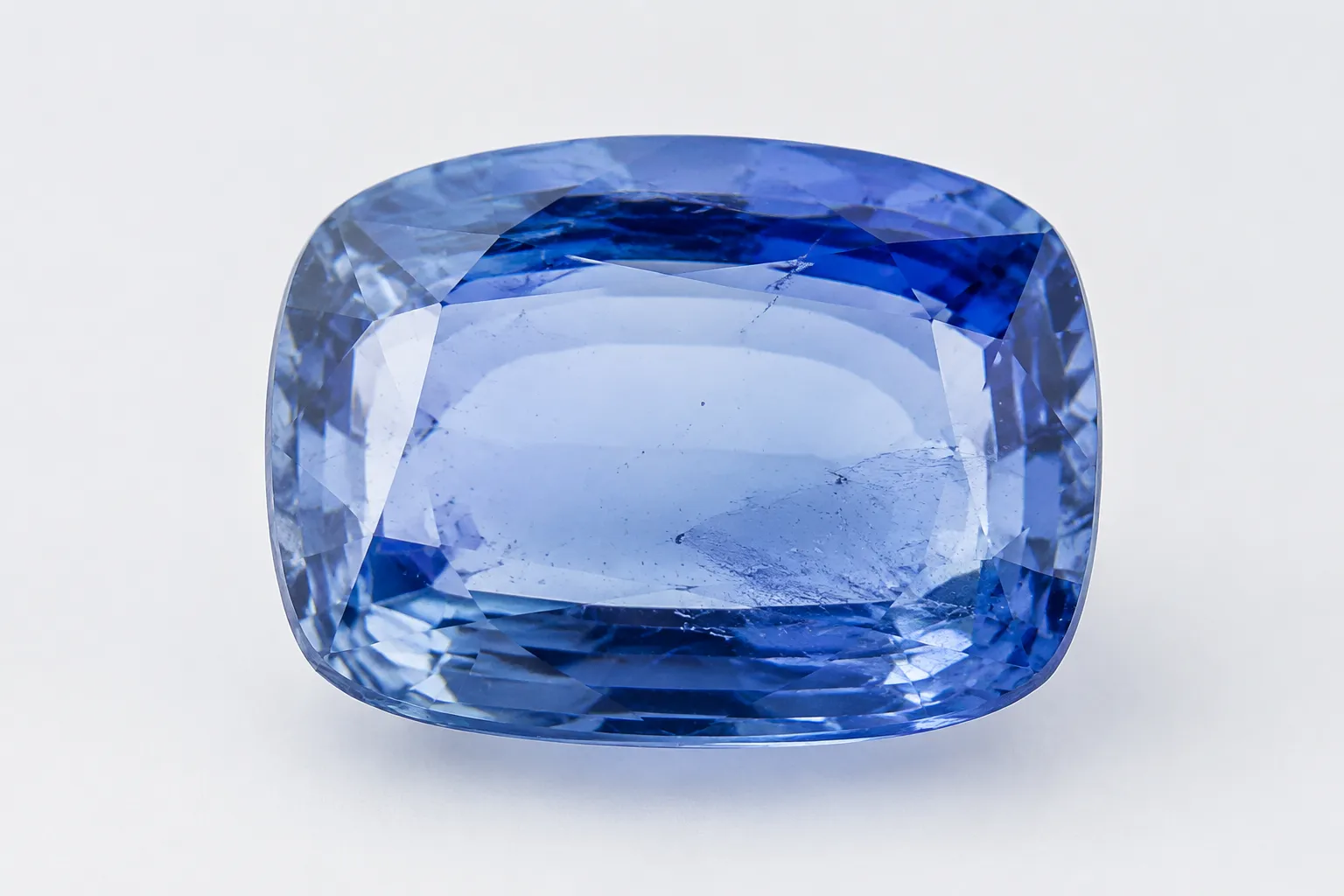
A listing shows a stone with a dark rim, pale center, or sharply colored band. Before assigning a cause, describe where the color appears and check whether it remains attached to the same physical region across several views.
That is the practical purpose of gemstone color zoning observation. It separates a potentially stable distribution pattern from reflections, shadows, directional color effects, and photographic variation. Appearance can frame useful questions, but it cannot establish identity, natural origin, treatment status, provenance, grade, or value.
Describe the Color Before Explaining It
Color and color distribution are related observations, not interchangeable ones. Begin with three color attributes:
- Hue: the perceived color family, such as blue, green, red, or an intermediate hue.
- Tone: how light or dark the color appears.
- Saturation: the apparent strength of the color.
Keep promotional adjectives out of this first description. Words such as “rich,” “deep,” “vivid,” or “glowing” may blur tone, saturation, lighting, and photographic brightness.
Then record the spatial pattern independently:
- Even: similar color across most visible regions.
- Banded: color arranged in lines or layers.
- Patchy: irregular areas differ in hue, tone, or saturation.
- Graduated: color changes progressively rather than at a sharp boundary.
- Rim-concentrated: stronger color appears near an outer edge.
- Core-concentrated: stronger color appears toward the center.
- Geometric: color occupies a wedge-shaped, hourglass-shaped, or otherwise recognizable region.
- Orientation-dependent: apparent color changes substantially with viewing direction.
A useful note might read: “A darker blue band is observed near the left edge, while the center appears lighter and less saturated.” It records what the image supports without assigning a mechanism.
What Uneven Color or Zoning Can Show in a Crystal Photo
Uneven color in crystal photos shows that visible regions are returning or transmitting light differently under the photographed conditions. It also identifies a pattern worth tracking in another view.
Research on particular gemstones has documented color bands and core-to-rim differences alongside chemical or spectroscopic variation. For example, the study Genesis of Color Zonation and Chemical Composition of Penglai Sapphire in Hainan Province, China examined zoning with analytical methods beyond visual inspection.
Such work supports a limited interpretation: changing growth conditions and differences in chemical incorporation may accompany visible zoning in some materials. It does not provide a shortcut for assigning that mechanism to a retail image. The analytical result came from measurements unavailable in ordinary listing photographs.
Use visible geometry as a description, not a diagnosis.
| Observed pattern | Reasonable description | What remains unresolved |
|---|---|---|
| Dark line crossing part of the stone | Banded color distribution | Whether growth, orientation, processing, or another cause produced the appearance |
| Stronger color around the outside | Rim-concentrated color | Whether the rim differs chemically or was affected by processing |
| Dark center with a paler exterior | Core-concentrated color | Why the center appears darker |
| Irregular colored areas | Patchy distribution | Whether the patches belong to the material, inclusions, reflections, or imaging |
| Smooth light-to-dark transition | Graduated distribution | Whether the transition is spatially stable or produced by light and depth |
| Color changes during rotation | Orientation-dependent appearance | Whether pleochroism, reflection, extinction, or several effects are involved |
None of the unresolved causes can be settled from geometry alone.
Compare the Same Physical Region Across Views
One photograph can make a reflection resemble a band or place a shadow over the apparent core. Multiple views become useful when you track the same physical region instead of treating each image as an unrelated composition.
Choose a landmark: a corner, fracture, inclusion, facet junction, drill hole, or surface mark. Follow the nearby color while the object rotates.
When the pattern stays attached to the stone
A band or patch that remains beside the same landmark across several orientations is more consistent with a stable spatial feature. Record its boundary, width, hue, tone, and saturation.
Stability strengthens the observation. It does not explain the cause.
When the pattern moves or disappears
A dark or colored area that travels across facets may be associated with reflection, extinction, changing light paths, or camera position. Its disappearance does not necessarily show that the first image was misleading. Transparent and faceted objects can change substantially with orientation.
Compare front, side, and oblique views when available. A slow rotation video adds continuity, although compression, automatic exposure, and moving reflections still affect the result.
When there are no clear landmarks
Polished beads, spheres, and uniform cabochons are harder to track. Ask the seller to keep a fixed reference visible during rotation, such as a drill hole, base, label, or small surface feature.
Without a reference point, apparent movement remains difficult to interpret.

Color Zoning and Pleochroism Are Different
Color zoning concerns where color is distributed within an object. Pleochroism concerns how color appearance varies with viewing direction in certain optically anisotropic materials.
The two can resemble each other in a still image. A faceted stone also combines light traveling along different paths, so the result may be more complicated than a clean directional color change.
The controlled study How to facet gem-quality chrysoberyl: Clues from the relationship between color and pleochroism, with spectroscopic analysis and colorimetric parameters found that apparent color depended on factors including crystallographic orientation, lighting, light-path length, and chromophore concentration. Its findings support treating pleochroism as direction-dependent behavior rather than another name for a band or patch.
Rotation can reveal which features change. It cannot by itself separate pleochroism from every reflection, cutting effect, or spatial variation.
Account for Lighting, Background, and Camera Processing
A stone can look different under daylight, warm indoor light, and other sources because each source provides a different balance of wavelengths. Apparent hue and saturation may shift even when the object has not changed.
Backgrounds affect perception as well. In The Impact of Munsell Neutral Grey Backgrounds on Tsavorite’s Color and Study on the Evaluation Method of Color Gem Cutting, researchers controlled illumination, background, angle, and photographic distance because those variables influenced color evaluation. The method applied to the studied samples and conditions; it was not a universal retail photography standard.
When comparing listing images, note whether:
- The stated lighting remains consistent.
- The background changes between views.
- Shadows or highlights conceal the suspected zone.
- One image appears markedly warmer, cooler, brighter, or more saturated.
- The object is shown over both light and dark backgrounds.
- Exposure changes during rotation.
- Reflections carry color from nearby objects.
A neutral-looking background can improve comparison, but it cannot establish color accuracy. A white surface may be warm or cool, while camera processing can render it neutral and alter the stone at the same time.
White balance is one variable
White balance adjusts how a camera or processing system represents the illumination. Its result depends on capture conditions, the chosen reference, camera processing, and later edits. A listed Kelvin value or the phrase “color corrected” does not resolve those variables.
The study Measurement of Gem Colour Using a Computer Vision System: A Case Study with Jadeite-Jade compared controlled computer-vision results with colorimeter measurements and discussed limits involving transparency, measurement area, and light movement through the material. Those measurements should not be equated with phone photographs or visual judgments made on a screen.
Displays introduce further variation through brightness, color settings, ambient light, and screen technology. Compare stable patterns and relative differences before relying on an exact displayed color.

Separate Observation, Seller Wording, and Interpretation
A disciplined listing audit keeps four evidence layers apart.
-
Record what is observed
A medium-dark green area is observed along one edge in two seller-supplied photographs. It appears less prominent in the rotation video.
This wording identifies the supplied material and does not assume that the images reproduce the object perfectly.
-
Record what the seller states
The seller states that the object is a named gemstone and provides a treatment or origin description.
Check whether the statement applies to the exact item. Group listings may combine general material descriptions with photographs of several objects.
-
Keep several explanations open
A stable band may be consistent with color zoning, while depth, cutting, inclusions, reflections, and directional behavior may modify its appearance. A rim or core pattern can raise a treatment question without answering it.
The available visual evidence does not support diagnosing diffusion, irradiation, synthesis, or another process from a rim, core, band, or facet-junction concentration alone.
-
Identify what requires analysis
Testing is needed to confirm consequential claims about identity, treatment, synthesis, or geographic origin. The appropriate methods depend on the material and the claim under review.
Even Color Has Limits
Apparently uniform color deserves the same discipline as visible bands and patches. It does not establish uniform chemistry or rule out treatment or synthesis.
Several conditions can make color appear more even:
- Low image resolution
- Soft focus or strong light diffusion
- Shallow depth of field
- Reflections covering internal detail
- Dark exposure
- High saturation
- An angle that conceals a zone
- Cropping that removes contrasting regions
The reverse also applies. Internal or compositional variation may not produce an obvious zone under a particular viewing condition. Visible uniformity and measured uniformity answer different questions.
Audit How the Listing Handles Color
Image quality is only part of the purchase decision. Disclosure and return terms matter when visual evidence remains ambiguous.
Confirm that every image shows the same object
Match inclusions, fractures, shape, dimensions, drill holes, and surface marks where possible. Changing physical details may indicate that the photographs show different items or illustrate a product category rather than the exact object offered.
Then note where the band, patch, rim, or core appears: the main photograph, side and rear views, close-ups, handheld images, video frames, or photographs under different stated lighting. A polished studio image and a handheld view need not match exactly, but a large unexplained difference deserves clarification.
Translate adjectives into specific questions
When a description says “deep color,” ask whether it means darker tone or stronger saturation. When it says “even color,” determine whether enough orientations are shown to support that description.
- What light source was used for each image or video?
- Do all images show the exact item for sale?
- Were hue, saturation, exposure, or white balance adjusted?
- Can the seller provide another orientation under the same lighting?
- Is the visible band, patch, rim, or core addressed in the description?
- What treatment information is disclosed for this item?
- Does the return policy permit inspection after delivery?
Editing controls and warm lighting can alter presentation, but their availability does not show that a seller acted deceptively. Judge the specific mismatch, omission, or unsupported statement in the listing.
Common Shortcuts That Misread the Evidence
“Uneven color means the material is artificial”
Uneven distribution occurs in independently documented natural crystals. That does not establish that a particular zoned object formed naturally, because different causes can produce similar visible patterns.
“A familiar-looking band settles the origin”
Origin findings in material-specific research depend on analytical evidence and suitable comparison data. Resemblance to a published photograph is insufficient.
“A colored rim identifies a treatment”
A rim-concentrated pattern is an observation. It may be consistent with several explanations and does not identify a process.
“The pattern disappears, so it was only a reflection”
Rotation changes reflections, extinction, directional color appearance, and effective light paths. A spatial feature can become difficult to see from some directions.
“A white background makes the image accurate”
Background control can improve consistency, while illumination, exposure, processing, capture settings, and display conditions remain relevant.
“Uniform color leaves nothing else to investigate”
Even-looking color leaves chemistry and processing unresolved. The selected angle or exposure may also conceal variation.
Choose a Proportionate Purchase Action
Match the next action to the importance of the unresolved claim and the consequences of being wrong.
- Proceed using the listing: The exact object appears from several useful angles, the observed distribution is acceptable to you, the description is internally consistent, and the return terms cover a material mismatch.
- Request better views: Only one optimized image is supplied, the suspected zone cannot be tracked, or the photographs differ without explanation. Ask for consistent orientations under stated lighting and, where feasible, a continuous rotation video.
- Request clearer disclosure: The seller makes identity, treatment, synthesis, or origin statements without specifying what applies to the exact item. A written answer is more useful than another promotional adjective.
- Review return protection: Small appearance differences matter, but remote images cannot resolve them. Confirm inspection deadlines, exclusions, shipping responsibilities, and conditions for return.
- Obtain testing: Identity, treatment, synthesis, or origin materially changes the purchase decision. Visual inspection can organize the questions, but testing is needed to confirm the result.
Begin with one focused request: ask for three consistently processed views that keep a recognizable landmark visible during rotation. If the color concentration stays attached to that region, the observation becomes stronger. The cause remains an open question.
Sources
- Factors in Colored Stones that Interact to Affect Value
- Genesis of Color Zonation and Chemical Composition of Penglai Sapphire in Hainan Province, China
- How to facet gem-quality chrysoberyl: Clues from the relationship between color and pleochroism, with spectroscopic analysis and colorimetric parameters
- Measurement of Gem Colour Using a Computer Vision System: A Case Study with Jadeite-Jade
- The Impact of Munsell Neutral Grey Backgrounds on Tsavorite’s Color and Study on the Evaluation Method of Color Gem Cutting
- Analysis of Gemstones at GIA Laboratories